| I
play in three finger style, but I have been using a banjo
with a semi-fretless neck to play the old-time repertoire.
Actually, I have three semi-fretless banjos, each is fretless
up to the fifth fret. While I rarely use closed position chords
up the neck when playing old-time music, I do use some fairly
complex left hand fingerings in those upper regions, which
I would not be able to execute without the benefit of frets.
Hence the semi-fretless. I
built the first semi-fretless neck, which was for a Paramount
pot, about twelve years ago. I have had a local luthier
make two more for me since then, one is a short scale, so
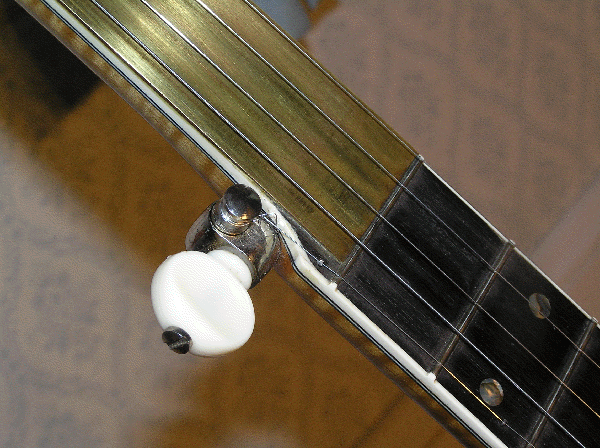
I can tune the banjo to open A. I use a brass plate, which
tapers down to a knife edge starting about halfway between
the 4th and 5th fret position, and ending right behind the
5th fret. Thus the 5th fret is functional. With the first
neck I made, I first tried using rosewood veneer for the
surface, but the result was too muted for my taste, so I
changed over to brass, which is crisper in tone. I do try
to stop the strings along the fretless part with the nail
whenever possible, but it often isn't possible. There is
a muted quality that comes with the fretless that is part
of the trade off to get the flexibilty in intonation that
is so unique and exciting. But then, life is always about
trade-offs, and compromises with perfection. I have since
added to more semi-fretless banjos to my arsenal. One is
a Tubaphone pot with a regular scale neck, shown above,
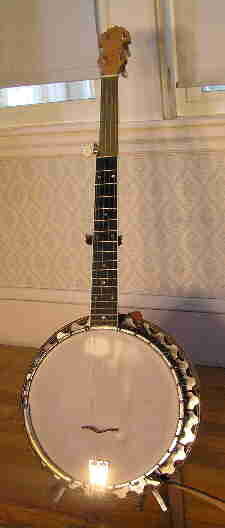
and the other a short scale Paramount, shown in the image
below. Both of those necks were made by Steve Pierce, a
luthier in Lawrence Massachusetts.
In addition
to producing liquid slides, there is another utility to
a fretless fingerboard, the ability to find distinct notes
between the notes of the conventional chromatic scale. I
think a lot of the old time modal tunes that we assign to
either Dorian or Mixolydian mode are actually in between,
because they use a scale which instead employs the quartertone
which is between the major and minor third. This is sometimes
called the neutral third. One might speculate that the the
Dorian and Mixolydian scales are merely derivations of this
a more ambiguous scale, with the Dorian sounding tunes being
those where the performer had a tendency to sing or play
the note closer to the true minor third, and the tunes we
think of as Mixolydian those where the singer or musician
leaned more towards the major.
To
hear how the semi-fretless banjo sounds finger picked, listen
to Chilly Winds
on my short scale Paramount, tuned aEABE..
|